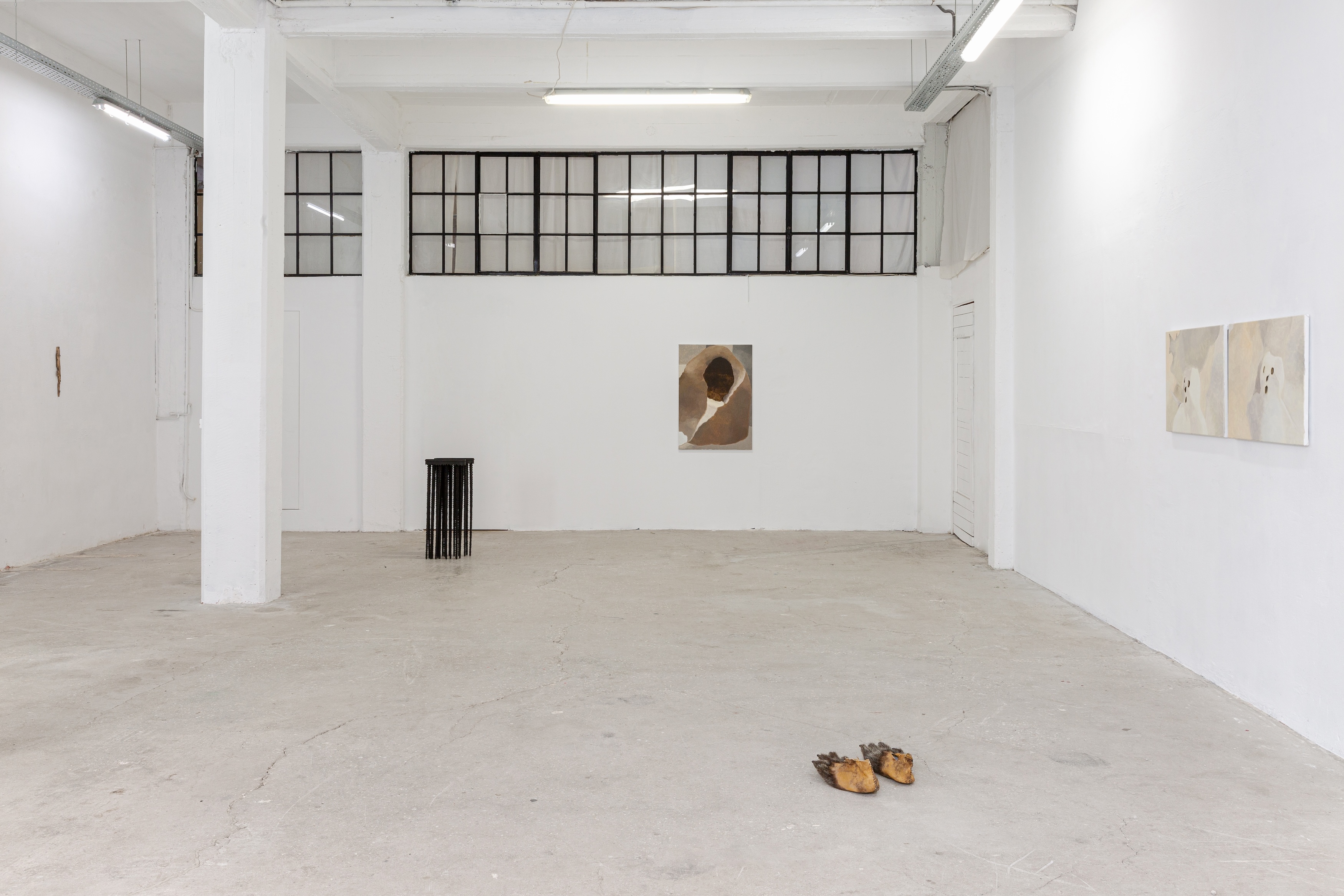
Tcharendar is a word from the patois of the Hautes-Alpes referring to the moment when bread is made to last through the winter. In Alpine villages, where seasonal cycles long structured collective life, this preparation was far more than a domestic task. It marked a shared moment within an economy of subsistence in which foresight, the repetition of gestures, and the careful use of resources shaped everyday existence. Objects, tools and skills circulated within this web of practices: they were repaired, passed on, adapted and sometimes transformed from one generation to the next.
It is within this horizon that Sébastien Bonin's practice takes shape. Having grown up in this region, the artist draws on a repertoire of forms connected to rural and artisanal labour. Yet his work is neither reconstruction nor ethnographic testimony. Through painting and sculpture he performs a displacement: everyday objects become autonomous forms, detached from their immediate function while still carrying the memory of the gestures that produced them.
The sculptures often originate in modest elements drawn from this material world. Shoes, for instance, appear transformed into bear's feet, as if the domestic object were sliding towards a more archaic or animal dimension. Mountain crampons—tools designed to grip ice and rock—are isolated and presented as almost abstract forms, revealing an unexpected geometry. Elsewhere, objects associated with agricultural or alimentary practices—sticks used for beating hay, cones for unleavened bread, or straw mats employed in the maturation of cheese—are recast in bronze. This translation into metal introduces a temporal tension: objects conceived for use, wear and replacement are suddenly stabilised in a material associated with durability and memory.
Painting develops another dimension of this inquiry. Motifs often appear fragmented or repeated, as if the images retained only certain elements of a larger scene. One recognises wooden fences, agricultural structures exposed to the shifting path of the sun, wooden patterns used in the making of shoes, or tools associated with textile practices. The human figures that occasionally appear—sharpening a blade, shaping a piece of wood—are not treated as portraits. Rather, they function as operators of gestures: bodies engaged in a precise action, situated within a chain of knowledge and technique.
What is at stake in these works is therefore not the simple representation of a rural world, but an attempt to render perceptible a material culture in which forms emerge from use and repetition. The objects the artist summons testify to a relationship with the world shaped by daily experience: a way of working with available materials, repeating learned gestures, and slowly transforming forms over time.
In this sense, Bonin's practice resonates with what Pierre Bourdieu described as habitus: a set of embodied dispositions, acquired through practice and repetition, which orient ways of doing, perceiving and inhabiting the world. Gestures transmitted in workshops, farms or homes become a silent memory inscribed in both bodies and objects.
The works gathered in Tcharendar offer a meditation on this memory. By isolating forms drawn from everyday labour, reproducing them, and translating them into different materials or scales, the artist reveals the invisible structures that sustain material life. Tools become signs, gestures become rhythms, and objects become archives of practice.
Through these displacements, sculpture and painting do not seek to fix a static tradition. Rather, they show how forms continue to circulate, transform and be transmitted. Like the moment of tcharendar itself, when the community prepares today what will allow it to endure the winter, the works occupy a space between memory and continuity, where gestures from the past find new forms through which to persist in the present.
Ma. Inés Rodriguez
Brussels, 2026
ofluxo.netdaily-lazy.com